
What Supplier Verification Can and Cannot Prove
Supplier verification is a buyer-side due-diligence process. Its purpose is to reduce avoidable uncertainty before money moves. For a dental order, that usually means checking whether the selling company exists, whether the quotation and documents identify the same legal party, whether the product information is coherent, and whether the supplier can provide evidence that fits the buyer's order stage. It is not the same as giving regulatory approval, issuing a certificate, proving clinical safety or guaranteeing that every unit in a later shipment will be defect-free.
A factory audit is different. It normally focuses on physical site conditions, management systems, production capacity, equipment, staff, storage, process control and quality records. A buyer may need an audit when the order value is high, the supplier claims to be a manufacturer, the product is complex, or the buyer will rely on the supplier for repeated production. Supplier verification can show whether the audit is worth arranging; it cannot replace seeing the site when the site itself is the risk.
Document review is also different. It compares business licenses, quotations, pro forma invoices, certificates, declarations, test reports, labels, manuals and product photos to identify mismatches. The goal is consistency and traceability. For example, if the quotation uses one English company name, the payment instruction uses another, and the certificate holder is a third company, the buyer needs an explanation before paying. A document review can flag the mismatch, but it should not pretend to decide legal admissibility in the buyer's destination market.
Product inspection comes later. A pre-shipment inspection checks actual goods, packaging, labels, accessories, quantities and visible workmanship after production reaches an inspectable stage. A pre-deposit supplier verification cannot inspect goods that do not yet exist. It can, however, identify what evidence should be saved now so that a later pre-shipment inspection for dental products has a clear approved reference.
Laboratory testing, certification and regulatory approval are specialist processes. An accredited laboratory can test according to a defined method. A certification body or notified body may assess conformity under a specific framework. A regulator or customs authority may apply destination-market rules. Supplier verification should respect those boundaries. The practical question before a deposit is narrower: does the available evidence justify proceeding, pausing, asking for clarification or arranging deeper checks?
The Buyer Scenario Before a Deposit
Most verification problems appear when a buyer has already received a persuasive quotation. The sales contact may respond quickly, the catalogue may look professional, and the sample photo may match the buyer's expectation. The buyer may also be under pressure because a distributor, clinic group or private-label customer wants a launch date. At that moment, the deposit feels like the gateway to production. It is also the point where the buyer loses leverage if basic facts have not been checked.
For dental equipment and dental supplies, the risk is rarely just "is this company real?" A real company can act as a trader. A trader can be a legitimate partner if the buyer understands the role and accepts it. The problem starts when the commercial story and the evidence do not match. A supplier may call itself a factory while the business scope, address, photos and certificate holder suggest otherwise. A certificate may belong to a related manufacturer but not to the entity asking for payment. A model number on a brochure may not match the model listed on a declaration or test report. A label may show an English brand that the Chinese factory does not own.
This is why the first decision is not whether the supplier sounds trustworthy. The first decision is whether the evidence is coherent enough to support a deposit. If the buyer is still comparing companies, a lightweight check may be enough to remove obvious risks. If the buyer is about to send a significant deposit, the check should be deeper and should create a record that can be used later during dental supplier verification in China, production monitoring, shipment inspection or warranty discussions.
Step 1: Confirm the Legal Counterparty
Start with the Chinese legal name. English names can be useful for communication, but many Chinese suppliers use multiple English names across websites, catalogues, platform profiles, email signatures and invoices. The legal identity is usually anchored in the Chinese company name and the Unified Social Credit Code. Ask the supplier to provide a business license copy, the Chinese company name in text form, the registered address, the legal representative name and the official payment beneficiary.
Then compare the business license with public registry evidence where available. The official Chinese enterprise information system is a starting point for basic company information, while customs registration information can be relevant for import/export activity. These checks help confirm that the entity exists and that the buyer is not dealing only with a brand name, website name or unrelated payment account. They do not prove that the company is an appropriate dental manufacturer.
The payment account deserves special attention. If the pro forma invoice asks the buyer to pay a company that is not the quoted supplier, the buyer should request a written explanation before paying. There may be legitimate reasons, such as a group company or export agent, but the explanation should be documented. The buyer should understand who is contractually responsible, who receives the money, who issues the invoice, who appears on export documents and who will handle disputes.
The address also matters. Compare the registered address, office address, factory address, website address and any address printed on certificates or labels. One mismatch does not automatically prove a problem, especially when companies have offices, factories and warehouses in different locations. But unexplained address changes can indicate that the supplier is a trading company, a sales office, a related entity or a party using another manufacturer's documents. A buyer that needs factory-direct production should resolve this before the deposit.
| Evidence to check | What to compare | Warning sign before deposit |
|---|---|---|
| Business license | Chinese name, Unified Social Credit Code, registered address and business scope | Supplier refuses to provide the Chinese legal name or provides only an English trading name |
| Pro forma invoice | Seller name, payment beneficiary, bank account country and contract party | Beneficiary is unrelated to the quoted supplier and no written explanation is given |
| Website and catalogue | Brand name, company name, address, phone number and product scope | Website presents factory capability but documents point to another manufacturer |
| Certificate or declaration | Certificate holder, manufacturer, model number and product category | Certificate holder does not match the supplier or the ordered product |
| Export evidence | Shipper name, exporter role and customs registration context | Supplier claims export experience but cannot provide coherent export-party information |
Step 2: Compare Documents, Names and Product Models
After identity, move to document consistency. A dental buyer should not treat a pile of files as proof simply because the files look official. The useful question is whether each file supports the exact product and supplier relationship in front of the buyer. For a dental chair, compressor, handpiece, curing light, sterilizer, suction unit, cabinet, imaging accessory or private-label item, model numbers and product descriptions can be surprisingly inconsistent across catalogues, labels and certificates.
Ask the supplier for the quotation, pro forma invoice, business license, product catalogue page, product specification sheet, certificate or declaration copies, test report if available, label artwork or photos, packaging information, user manual or instructions for use, warranty terms and any sample approval record. Do not ask for everything blindly if the order is small, but do ask for enough evidence to support the deposit decision. The point is to compare documents, not merely collect them.
For U.S.-bound medical device orders, FDA import and registration/listing pages are useful context because they show that medical device imports are subject to applicable requirements and that establishment/device information has a defined role. For EU-bound orders, the MDR and European Commission guidance context matters because importer and distributor roles carry obligations. A buyer-side verification article should not turn those sources into a legal opinion. Instead, it should use them to explain why document names, product identity and responsible parties must be handled carefully.
Be cautious with certificates. A CE certificate, FDA registration screenshot, ISO certificate or test report can be genuine but still limited. It may cover a quality management system rather than a product. It may list a manufacturer but not the exporter. It may cover a product family but not the exact model or configuration. It may have expired. It may rely on a legal entity that is not the one selling to the buyer. It may be relevant in one market but not sufficient in another.
This is where a structured dental compliance document check can prevent false confidence. The buyer should record what each document claims, what it does not claim, and which document details need specialist confirmation. If the supplier reacts defensively to reasonable document questions, that is itself useful information before the deposit is released.
| Document | Buyer question | Practical follow-up |
|---|---|---|
| Quotation and invoice | Is the seller the same legal entity that receives payment? | Request a revised invoice or written explanation for any third-party payment route |
| Product specification | Does the quoted model match catalogue, label and certificate references? | Ask for model-level confirmation and keep the approved version for later inspection |
| Certificate or declaration | Who is named as manufacturer, holder or responsible party? | Compare names with business license and product label; refer unclear regulatory conclusions to a specialist |
| Label and manual | Do brand, model, manufacturer and language match the buyer's target market plan? | Request pre-production artwork review before packaging is printed |
| Warranty terms | What evidence will be required if defects appear after delivery? | Keep serial, batch, photo, video, installation and use-condition evidence requirements in writing |
Step 3: Check Whether the Supplier Fits the Order
Supplier verification should connect the company evidence to the order. A supplier can be acceptable for simple accessories but unsuitable for complex equipment. A sales team can be responsive during quotation and weak during production follow-up. A factory can make one product category well and outsource another. The buyer should therefore ask, "Can this supplier support this exact order at this exact stage?"
For new supplier screening, focus on identity, product category fit, communication quality and document coherence. For sample confirmation, focus on whether the sample supplier, sample model and quoted bulk model are the same. For deposit release, focus on payment party, contract terms, production references, packaging requirements, certificate/document consistency and what evidence will be created during production. For final payment, the focus shifts to inspection, packing, labels, carton count, loading evidence and shipment documents. The same supplier may pass one stage and still need more checking at the next stage.
A common mistake is to rely on a good sample as if it were supplier verification. A sample proves only that a sample was received and observed. It may not prove the production source, material consistency, component brand, electrical configuration, software version, sterilization cycle performance, packaging strength or label accuracy of the bulk order. Buyers dealing with sample-to-bulk risk should also read about the golden sample trap in dental sourcing because the approved sample should become a reference file for later checks, not a reason to stop checking.
Another common mistake is to treat "factory" and "trading company" as moral categories. The real question is role clarity. A trading company can add value if it coordinates multiple suppliers, handles export, communicates well and accepts transparent responsibility. A factory can still create risk if it lacks export experience, document discipline or stable quality control. The buyer needs to know which party is doing what. A practical comparison is available in the guide to factory vs trading company dental sourcing.
Use supplier questions that force specific answers. Ask what legal entity will receive payment, what factory will produce the goods, what product model will be written on the invoice and label, what documents will be supplied before production, what evidence will be shared during production, and what happens if inspection finds a mismatch before shipment. Vague answers are not automatic rejection, but they show where the buyer should add conditions before paying.
Step 4: Decide What Needs Remote, On-Site or Specialist Review
A pre-deposit workflow should separate remote checks from on-site checks. Remote checks are useful for company identity, document comparison, public-source review, website consistency, quotation logic and basic product evidence. They are fast and relatively low friction. They are also limited because the supplier controls much of the material being sent.
On-site checks become important when the buyer needs to confirm a physical location, production line, warehouse, sample room, packing area, staff presence, order materials or visible manufacturing capability. For a high-value dental equipment order, the cost of an on-site check may be small compared with the risk of sending a deposit to the wrong party. On-site evidence can also make later negotiations clearer because the buyer is no longer relying only on email claims.
Specialist review is needed when the question becomes legal, regulatory, customs, laboratory or clinical. A buyer-side verification provider should not claim to approve a device for a market. If the buyer needs to know whether a product can be placed on a specific market, whether a certificate is sufficient, whether a label meets destination rules, or whether a device classification is correct, the buyer should involve a qualified regulatory consultant, legal adviser, customs broker, notified body, accredited laboratory or other appropriate professional.
The practical value of supplier verification is in routing the question correctly. If the issue is a mismatched payment beneficiary, the buyer needs commercial clarification and contract alignment. If the issue is a certificate holder mismatch, the buyer needs document explanation and possibly regulatory review. If the issue is whether the factory can produce the quoted configuration, the buyer may need a site visit. If the issue is whether finished goods match the sample, the buyer needs inspection at the right production stage.
| Method | Can help confirm | Cannot confirm by itself |
|---|---|---|
| Remote identity and document review | Company existence signals, name consistency, payment-party mismatch, product-document coherence | Physical production capability, finished-goods quality or destination-market approval |
| Video call or live walk-through | Whether a contact can show a site, sample room, package or documents in real time | Full factory capacity, long-term process control or complete inventory accuracy |
| On-site supplier visit | Address reality, visible operations, sample/product evidence and some process observations | Laboratory performance, legal compliance or every future production batch |
| Pre-shipment inspection | Finished goods, packaging, labels, accessories, quantities and visible workmanship at inspection time | Regulatory clearance, hidden defects outside the inspection scope or future warranty behavior |
| Specialist regulatory or laboratory review | Defined legal, testing, classification or conformity questions | Commercial honesty, supplier responsiveness or production follow-through |
Supplier Verification Checklist
Use this checklist before releasing a deposit. It is designed to create a decision record, not to replace professional advice.
- Request the Chinese legal company name, Unified Social Credit Code, business license copy, registered address and payment beneficiary.
- Compare the supplier's Chinese name with quotation, invoice, bank account, email signature, website, catalogue and certificate holder names.
- Confirm whether the supplier claims to be manufacturer, trader, export agent, brand owner, distributor or group company, and record the role in writing.
- Ask which physical site will produce or assemble the ordered goods and whether an on-site visit can be arranged if needed.
- Compare product model numbers across quotation, catalogue, specification sheet, label artwork, certificate, declaration and manual.
- Check whether certificate dates, holder names, manufacturer names, product categories and model references are coherent.
- Ask what documents will be available before production, during production, before final payment and before shipment.
- Confirm packaging, label, language, plug, voltage, spare parts, accessories and branding requirements before the deposit.
- Define what evidence will be required if the supplier later requests final payment: photos, videos, carton list, serials, labels, inspection report or loading records.
- Decide whether the remaining uncertainty is acceptable, requires a supplier explanation, needs an on-site check or requires specialist regulatory review.
How to Handle Red Flags Before Paying
A red flag does not always mean the supplier is fraudulent. It means the buyer should not proceed as if the issue were resolved. The most useful response is to ask for a specific explanation, request corrected documents, and record the supplier's answer. If the answer is reasonable and supported by evidence, the buyer may continue with conditions. If the answer is vague, delayed or contradictory, the buyer should pause.
For example, if the bank beneficiary differs from the quoted seller, ask why. If the answer is that a related export company handles foreign currency payments, request documents showing the relationship and make sure the contract names the responsible party. If the supplier says the certificate belongs to a partner factory, ask whether that partner is the actual manufacturer for the order and whether the label and invoice will reflect that. If the supplier says the model number has changed, ask for an updated specification sheet and confirm which version will be inspected later.
Some issues should trigger escalation rather than negotiation. If a supplier refuses to provide a Chinese legal name, pressures the buyer to pay quickly, changes payment accounts without explanation, sends documents with obvious editing, cannot identify the manufacturer for regulated products, or asks the buyer to ignore model differences, the buyer should treat the deposit as high risk. A smaller trial order does not fix the underlying identity problem if the payment and document trail remain unclear.
The buyer should also avoid turning verification into an endless paperwork exercise. The goal is a decision. After checking identity, product-document consistency and order-stage evidence, the buyer should classify the result: proceed, proceed with conditions, arrange on-site verification, request specialist review, switch supplier or stop. That decision record will be useful if the order later moves into production monitoring, inspection, final payment or warranty follow-up.
Limitations and Next Step
Supplier verification can reduce preventable mistakes, but it cannot remove every risk from an international dental order. It cannot prove that every future production unit will match the sample. It cannot guarantee destination-market clearance. It cannot turn a general supplier into a qualified manufacturer for a regulated product. It cannot replace laboratory testing, notified-body assessment, legal advice, customs advice or market-specific regulatory review.
Verifiedental provides buyer-side document review, evidence collection and practical risk identification. It does not replace an accredited laboratory, notified body, legal adviser, customs broker or destination-market regulatory consultant.
The best next step is to build a pre-deposit evidence file. Save the supplier's Chinese legal name, business license, quotation, invoice, payment instruction, product specification, certificate copies, label photos, catalogue page, warranty terms and all clarification emails in one folder. Mark each item as matched, unclear or conflicting. If the unclear items involve regulatory status, product safety claims or import eligibility, send them to the appropriate specialist. If the unclear items involve supplier identity, factory role or payment route, resolve them before paying.
If the order is already moving toward final payment, this pre-deposit file remains valuable. It becomes the reference for inspection, packing checks, loading evidence and shipment document review. Buyers who release final payment without a clean evidence trail often struggle later because the supplier can argue that the buyer accepted a different model, label, package or entity. The article on evidence before final payment explains how the evidence file changes as the order approaches shipment.
Related dental sourcing guides
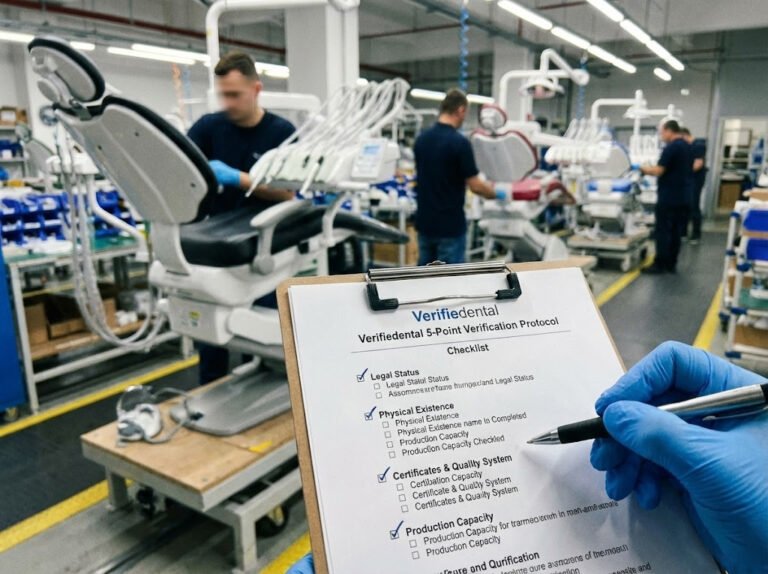
What Is Included in a Dental Product Pre-Shipment Inspection?
A practical evidence-based guide for overseas dental buyers checking a China supplier before paying a deposit.
Read guide →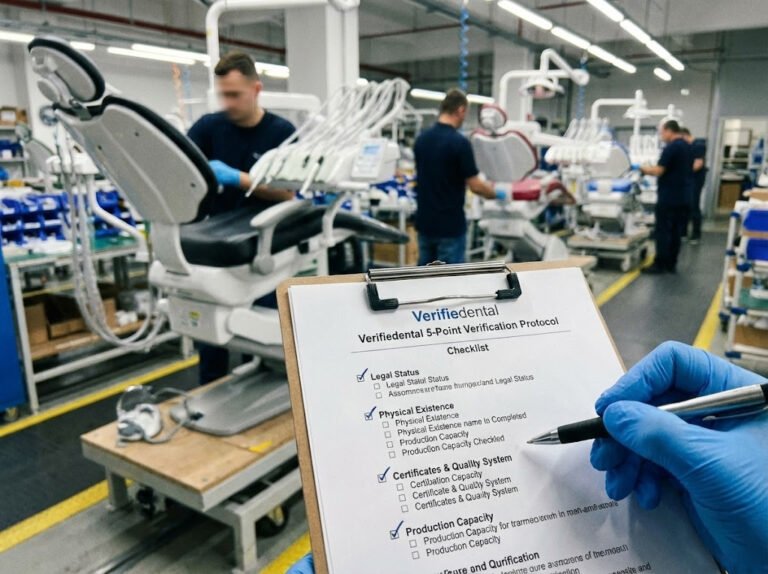
Dental Product Pre-Shipment Inspection Checklist
A practical evidence-based guide for overseas dental buyers checking a China supplier before paying a deposit.
Read guide →
Why Product Samples Do Not Guarantee Consistent Bulk Order Quality
A practical evidence-based guide for overseas dental buyers checking a China supplier before paying a deposit.
Read guide →