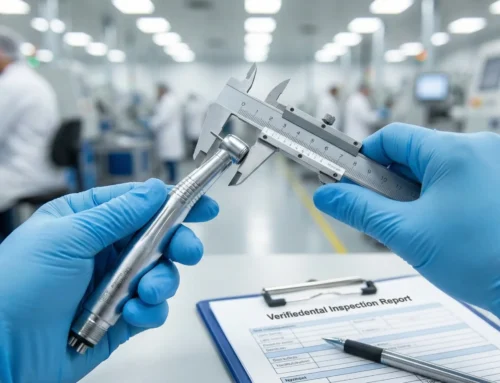
Summary
Sourcing dental equipment from China offers significant competitive advantages, but it comes with a prevalent risk known as the “Golden Sample” trap. This comprehensive guide explores why bulk orders often fail to match the flawless prototypes initially provided by suppliers—ranging from unauthorized material substitutions to inconsistent assembly line standards. We dissect the root causes of these quality discrepancies in the Chinese manufacturing context and provide actionable strategies, including strict Bill of Materials (BoM) enforcement and professional Production Monitoring (DPI), to ensure your imported dental units meet international quality, safety, and compliance standards.
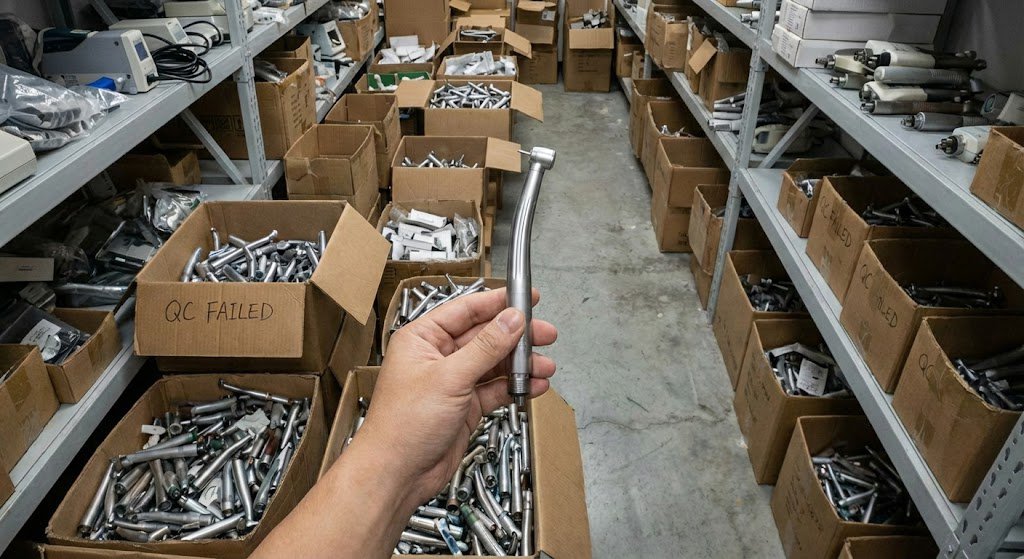
The Dream vs. The Nightmare
It is a scenario every international dental distributor dreams of, and subsequently, dreads.
You meet a new supplier at a trade show in Guangzhou or via Alibaba. Their catalog is impressive, their English is decent, and their pricing offers a margin you haven’t seen in years. You act cautiously: you order a sample unit—perhaps a flagship dental chair or a high-end autoclave.
When the sample arrives, it is perfect. The leather stitching is impeccable, the motor operates in a whisper-quiet hum, the plastic injection molding is smooth, and the internal tubing is organized with surgical precision. It is the “Golden Sample.”
Based on this tangible proof of quality, you confidently place a deposit for a 40HQ container. Three months later, the container arrives at your warehouse. You open the first box, and your heart sinks. The leather smells of cheap chemicals. The plastic casing has rough, unfinished edges. When you power it up, the motor vibrates noticeably.
What happened? Did you just get unlucky? Was it a “bad batch”?
No. You fell into the “Golden Sample Trap.”
In the complex world of China dental sourcing, the sample you receive is often a marketing tool, not a representation of manufacturing capability. Understanding why this happens—and how to prevent it—is the difference between a profitable import business and a warehouse full of unsellable scrap.
The Anatomy of the Trap: Why “Bait and Switch” Happens
To solve the problem, we must first understand the root causes. It is rarely malicious intent to defraud (though that exists); more often, it is a systemic issue within the manufacturing ecosystem in industrial hubs like Foshan.
Here is the deep dive into why your bulk order looks different from your sample:
1. The “Engineer vs. Temp Worker” Discrepancy
The sample unit you received was likely not built on the assembly line. It was hand-assembled by the factory’s Chief Engineer or their most skilled technician. They spent three days perfecting one unit, hand-polishing components, and ensuring every screw was torque-tested.
However, your bulk order of 50 dental units is being assembled by line workers. In peak seasons, factories often hire temporary labor to meet deadlines. These workers may lack the specific training to handle delicate dental unit PCBs or complex solenoid valve arrays. Without strict Standard Operating Procedures (SOPs) and on-site supervision, the “craftsmanship” of the sample disappears in mass production.
2. The Silent Material Substitution (Cost Fade)
This is the most dangerous aspect of sourcing dental medical devices in China. The sample was built with top-tier components to win your trust.
The Sample: Used a genuine Timotion or Linak motor (Denmark/Taiwan origin), hydrolysis-resistant PU tubing, and medical-grade silicone.
The Bulk Order: To maximize profit margins, the procurement manager swaps these for “equivalent” domestic alternatives. The Danish motor is replaced by a local copycat that looks identical but fails after 500 cycles. The PU tubing is swapped for PVC, which hardens and cracks after six months of water exposure.
This “Material Fade” is invisible to the naked eye. You won’t know the solenoid valve is inferior until it leaks in your client’s clinic.
The Invisible Risk: Sample vs. Bulk Order Comparison
| Critical Component | The “Golden Sample” (What You Approved) | The Bulk Order Risk (What You Might Get) | How Verifiedental Detects It |
| Electric Motor | Genuine Brand (e.g., Timotion/Linak).
Whisper-quiet (<45dB), smooth movement, 8000N thrust. | Generic Copycat.
High noise level (>60dB), overheats after continuous use, weaker lifting power. | We open the motor housing during DPI to verify the brand label and serial number, and test load capacity. |
| Upholstery (Leather) | Microfiber Leather.
Breathable, scratch-resistant, withstands alcohol disinfection without peeling. | Standard PVC.
Feels stiff, cracks within 6-12 months, reacts poorly to disinfectants. | We perform a “Thickness & Scratch Test” and check the backing material texture to confirm material grade. |
| Internal Tubing | Polyether-based PU.
Hydrolysis-resistant (won’t rot with water), anti-bacterial lining. | Polyester or PVC.
Becomes brittle and leaks after short-term water exposure; prone to biofilm buildup. | We check the tubing flexibility and markings. We can also perform a quick chemical reaction test on-site. |
| Solenoid Valves | Imported (Italy/USA).
High precision, rated for 1 million cycles, consistent water/air control. | Local Low-End Brand.
Inconsistent pressure, high failure rate leading to leakage or “dripping” handpieces. | We cross-check the valve brand against the BOM and test the On/Off responsiveness under high pressure. |
| Main PCB Board | Customized High-Grade.
Coated for moisture protection, designed for unstable voltage inputs. | Generic Standard.
No protective coating, sensitive to voltage spikes (high risk of burnout). | We inspect the circuit board layout and coating quality (conformal coating check) inside the unit chassis. |
3. The Subcontracting Web
Many “factories” visible on B2B platforms are actually assembly hubs. When their capacity is full, or if your order volume is considered “small” (less than 5 containers), they may quietly subcontract your order to a smaller, unregulated workshop down the street. The facility you visited (or video-called) isn’t the one making your goods. The quality control standards of the main factory do not apply to the subcontractor.
The True Cost of Blind Trust
Falling for the Golden Sample trap costs more than just the value of the goods. For a dental supply distributor, the ripple effects are catastrophic:
Reputation Damage: It takes years to build trust with local dentists and clinics. Selling one batch of faulty equipment can destroy that reputation overnight. If a dental chair fails during a patient surgery due to a faulty hydraulic pump, that dentist will never buy from you again.
The “After-Sales” Black Hole: Returning a container of dental chairs to China is logistically and financially impossible due to shipping costs and import duties. You are left with the burden of local repairs.
Regulatory & Compliance Risks: If you obtained CE MDR or FDA approval based on the technical file of the sample, but the bulk order uses different internal components, your compliance is technically void. In the event of a patient injury lawsuit, this discrepancy can lead to severe legal penalties.
The Solution: How to “Lock In” Quality
How do you bridge the gap between the Golden Sample and the Mass Production reality? You cannot rely on trust; you must rely on Verification and Process Control.
Step 1: The “Golden” BoM (Bill of Materials)
Never accept a Proforma Invoice that just says “Dental Unit Model A – $2000.” You must demand a detailed Bill of Materials (BoM) annexed to the contract. Specify the brand and model of critical components:
Motor: Brand X, Model Y, Thrust 8000N.
Tubing: Polyether-based PU, origin Germany/USA.
PCB: Conformal coating thickness specification. Verifiedental helps clients draft these technical contracts to ensure there is no ambiguity for the supplier to exploit.
Step 2: Seal the Sample
Once you approve a sample, do not just say “OK.” You must have the sample signed, sealed, and stored. Ideally, two samples are created: one stays with you, and one stays at the factory (sealed by a third party). This “Sealed Sample” becomes the undeniable legal standard for acceptance. If the bulk order deviates from this sealed unit by even 1mm, it is grounds for rejection.
Step 3: Don’t Wait for the End – Production Monitoring (DPI)
Most buyers make the mistake of only inspecting goods when they are packed and ready to ship (Pre-Shipment Inspection). By then, it is too late. The inferior motor is already buried deep inside the chair casing.
The antidote to the Golden Sample trap is During Production Inspection (DPI). This involves sending an inspector to the factory when 20% – 50% of the goods are produced. We open the “hood.” We check the components before they are assembled. We verify that the wiring harness follows the safety diagram. We catch the “Silent Substitution” while the factory can still fix it.
A Real-World Scenario
Consider a client of ours, a mid-sized distributor in Brazil. They ordered 80 dental units from a reputable Foshan supplier. The sample was perfect.
However, during a Verifiedental DPI (Production Monitoring) visit, our engineers noticed a discrepancy. The sample used a high-grade, multi-layer customized PCB designed to withstand voltage fluctuations common in Brazil. On the assembly line, we found the factory was installing a standard, generic PCB intended for the stable European grid.
The Result: If these units had shipped, 80% of them would likely have fried their motherboards within the first month of operation in Brazil. The Fix: We paused production immediately. Confronted with the evidence, the factory admitted the “mistake” and reverted to the correct PCB. The client’s delivery was delayed by 5 days, but they saved over $40,000 in potential replacement costs and protected their brand.
What Verifiedental Can Do For You
Verifiedental don’t just inspect; we act as your local partner, ensuring your interests are protected at every stage of the supply chain. We understand that in the dental industry, precision is not a luxury—it’s a requirement.
Here is how our comprehensive service suite eliminates the risks of cross-border sourcing:
Supplier Verification: We dig deep into financial health and legal standing to ensure you aren’t dealing with a shell company or a factory on the brink of bankruptcy.
Compliance Check: We validate every CE, FDA, and ISO certificate directly with issuing bodies, ensuring your imports meet all regulatory standards.
Production Monitoring (DPI): Our core differentiator. We put boots on the ground during manufacturing to catch material substitutions and assembly errors before they are sealed in the box.
Order Follow-up: We bridge the communication gap, translating not just language but cultural nuances, giving you real-time visibility into your order status.
Pre-Shipment Inspection (PSI) & Loading Check: The final firewall. We verify quantity, functionality, and packaging integrity, and supervise the container loading to prevent transit damage.
Warranty Enforcement: We stay with you after the sale. If issues arise, we leverage our local presence to enforce warranty terms and coordinate spare parts logistics.
With Verifiedental, you aren’t just buying inspection reports; you are buying certainty.
Conclusion: Trust, but Verify
The “Golden Sample” is a promise. Your job—and ours—is to ensure the factory keeps that promise.
In the high-stakes game of dental equipment manufacturing, relying on a sample alone is a gamble you cannot afford to take. The factories in China are capable of world-class quality, but they require precise management and constant vigilance to deliver it consistently.
Don’t let your next container be a surprise. Shift your strategy from “Passive Trust” to “Active Verification.”
Ready to secure your supply chain? If you are planning an order or currently have one in production, do not leave the quality to chance. Contact Verifiedental today. Let us go to the factory floor so you don’t have to.
Ready to Protect Your Investment?
The difference between a profitable shipment and a warehouse full of defects is often just one inspection.
Don’t leave your reputation to chance or rely on a “Golden Sample” that might not represent reality. Let Verifiedental be your eyes and ears on the factory floor in China. We ensure that the dental equipment you unbox is exactly the quality you paid for.
Your Next Step:
Get a Quote: Tell us about your current order, and we will provide a tailored inspection plan.
Free Consultation: Not sure which inspection service you need? Speak with our sourcing experts today.
[Click Here to Schedule Your Factory Inspection Now] Secure your supply chain with Verifiedental – because your peace of mind is our business.
Frequently Asked Questions (FAQ)
Q: What exactly is a “Golden Sample” in dental equipment sourcing?
A: A “Golden Sample” is a prototype unit provided by a manufacturer to a buyer for approval. It is typically hand-assembled by skilled engineers using top-tier materials to demonstrate the “best possible” quality. However, it often differs from the mass-produced units, which may suffer from lower-quality materials or assembly errors if not strictly monitored.
Q: Why isn’t a Pre-Shipment Inspection (PSI) enough to catch quality issues?
A: While PSI is essential for checking quantity and packaging, it often happens too late to fix internal quality issues. By the time a dental chair is packed, you cannot easily check the motor brand, internal wiring, or solenoid valve quality without disassembling the unit. Production Monitoring (DPI) allows us to catch these “hidden” substitutions while the unit is still being assembled.
Q: How can I legally ensure the factory sticks to the sample specifications?
A: You must attach a detailed Bill of Materials (BoM) to your sales contract, specifying the exact brand, model, and material of critical components (e.g., “Timotion Motor Model TA23” instead of just “Motor”). Additionally, using a third-party service like Verifiedental to seal and store a reference sample creates a binding physical standard for acceptance.
Q: Can Verifiedental help if I have already paid the deposit and production has started?
A: Yes. We can deploy an inspector to the factory for a During Production Inspection (DPI) within 24-48 hours. If we find discrepancies between your requirements and the actual production, we provide you with the evidence needed to pause production and demand corrections before the balance payment is made.