
Summary
China has become the global manufacturing hub for dental equipment, offering undeniable cost advantages for distributors and clinic chains. However, the path to a successful import is riddled with “invisible” risks that can turn a profitable deal into a financial disaster. This comprehensive guide dissects the six most critical hurdles in the sourcing process: identifying fake trading companies, avoiding the “Golden Sample” quality trap, ensuring regulatory compliance (MDR/FDA), verifying technical compatibility (Voltage/Hz), managing logistics safety, and planning for long-term after-sales support. We provide actionable strategies to navigate these challenges, ensuring your supply chain remains secure, compliant, and profitable.
Introduction: The Opportunity and The Minefield
For dental distributors worldwide, sourcing directly from China is no longer just an option; it is a strategic necessity. The price-to-performance ratio of Chinese dental units, autoclaves, and imaging equipment has improved dramatically over the last decade, allowing businesses to compete aggressively in their local markets.
However, international trade—especially in the medical device sector—is unforgiving. It is a minefield where a single oversight can lead to seized containers, legal lawsuits, or brand reputational suicide.
We often see buyers fixated solely on the FOB price. They calculate their margins based on the “best case scenario,” ignoring the systemic risks inherent in cross-border procurement. What happens if the factory you paid is actually a middleman with no assets? What happens if the dental chair motors burn out because of a frequency mismatch? What happens if the CE certificate is fake?
To succeed, you need more than a catalog; you need a roadmap. Below is the Ultimate Pre-Order Checklist, broken down into the six critical hurdles you must clear before you wire a single dollar.
Hurdle 1: The “Fake Factory” & The Middleman Tax
The Risk: Paying premium prices for low accountability.
The internet is a great equalizer, but it is also a great deceiver. On platforms like Alibaba or Made-in-China, a trading company operating out of a small apartment can look exactly like a manufacturing giant with a 50,000-square-meter facility.
The “Trader” Trap: Many entities posing as manufacturers are actually Trading Companies (Middlemen). While some traders offer value, many are “parasitic.” They add a 15-30% margin on top of the factory price, effectively eating your profit. More dangerously, they lack control over production. If the real factory delays your order or cuts corners on quality, the trader is powerless. If the trader goes bankrupt, your deposit disappears with them, and you have no legal claim against the actual manufacturer.
How to Spot the Difference:
Business License Scope: Does the Chinese Business License say “Production” or just “Wholesale/Sales” ? A true factory must have production in its authorized scope.
The “Video Call” Test: Ask for a spontaneous video call. Ask the salesperson to walk onto the production floor right now. If they make excuses (“I’m not at the factory today,” “The signal is bad”), it’s a red flag.
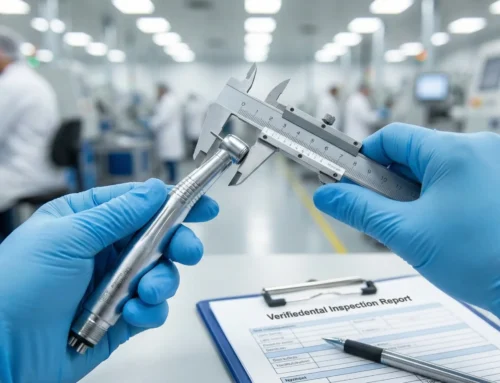
Audit Reports: A legitimate factory will have ISO 13485 audit reports and site verification documents.
The Fix: Supplier Verification. Never rely on the supplier’s word. A professional on-site audit is the only way to confirm you are dealing with the source.
Hurdle 2: The “Golden Sample” Illusion
The Risk: What you see is NOT what you get.
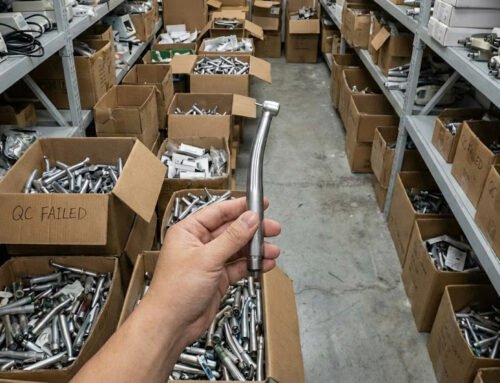
You successfully filtered out the traders and found a real factory. They sent you a sample dental unit. It’s flawless. The leather is soft, the operation is silent, and the finish is premium. You place a bulk order for a 40HQ container. When the container arrives, the nightmare begins. The plastic turns yellow, the motors vibrate, and the valves leak.
Why This Happens: This is the classic “Golden Sample” Trap.
The Sample: Built by the Chief Engineer, hand-assembled, using top-tier imported components (e.g., Timotion motors, American tubing) to win your business.
The Bulk Order: Built by temporary assembly line workers to meet a deadline. To widen profit margins, the factory quietly substitutes the imported components with cheaper domestic alternatives (“Material Fade”).
In the dental industry, consistency is key. A sample proves the factory can make a good product, but it does not prove they will make 50 of them consistently.
The Fix: Product Specificity & Monitoring. Do not just order “Model X.” Order “Model X with Bill of Materials V1.0.” And critically, implement Production Monitoring (DPI) to inspect the goods while they are on the assembly line, ensuring no unauthorized substitutions occur.
Hurdle 3: The Regulatory Minefield (Compliance)
The Risk: Customs seizure and illegal sales.
Medical devices are highly regulated. Bringing non-compliant equipment into your country is not just a business risk; it is a legal liability.
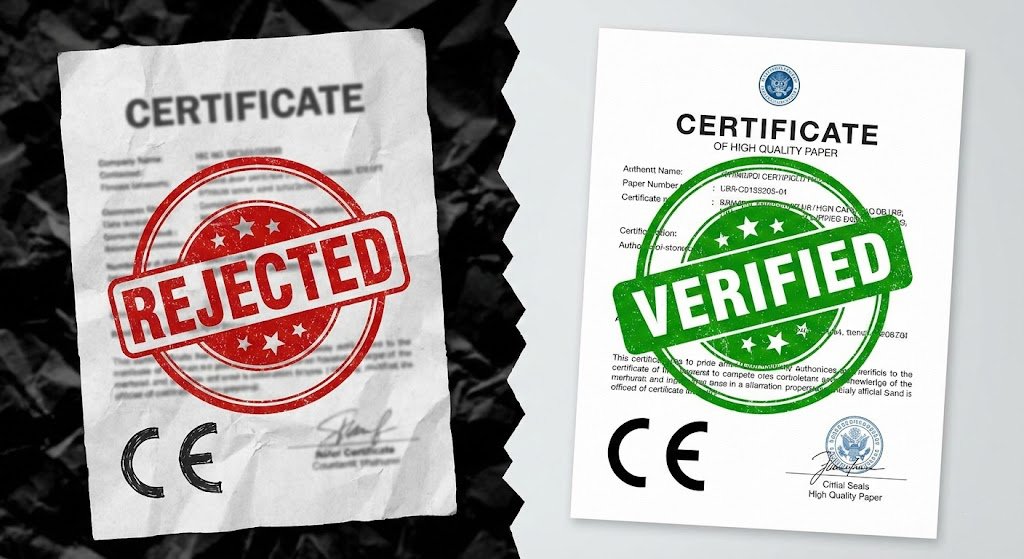
The “Fake Certificate” Epidemic: Many smaller workshops in China use deceptive practices regarding certification:
Expired Certificates: Using a CE certificate that expired three years ago.
“Borrowed” Certificates: Using a certificate belonging to another factory.
Photoshop Certificates: Yes, this happens. We have seen certificates from non-existent Notified Bodies.
The MDR Transition (Crucial for Europe): For European buyers, the shift from MDD (Medical Device Directive) to MDR (Medical Device Regulation) is critical. Many Chinese factories have not yet achieved MDR compliance. If you import Class IIa dental devices (like dental units) with old MDD paperwork, your goods may be blocked at the EU border.
The Fix: Compliance Check. Verify every certificate number directly with the issuing database (e.g., TUV, SGS, FDA database). Never accept a PDF as proof without verification.
Hurdle 4: The Invisible Incompatibility (Technical Specs)
The Risk: Equipment that fries or fails upon installation.
This is the most common technical oversight. A dental chair is an electromechanical system that depends on precise power and utility inputs.
The Voltage & Frequency Trap: China operates on 220V / 50Hz.
If you are in the USA/Canada (110V / 60Hz): You need a completely different transformer and motor system.
If you are in Saudi Arabia/Philippines/Brazil (220V / 60Hz): This is tricky. The voltage matches, but the Hertz (Frequency) does not. An AC motor designed for 50Hz runs 20% faster on 60Hz, leading to overheating, noise, and premature failure. You must specify 60Hz compatible motors.
Plumbing & Plugs:
Tubing Standards: Does your country use Metric (mm) or Imperial (inch) piping? A mismatch here means your local technicians cannot install the unit without expensive adapters.
Plug Types: It sounds trivial, but receiving 50 dental units with Chinese 3-pin plugs in the UK creates a terrible unboxing experience and extra labor costs.
The Fix: Detailed Technical Spec Sheet. Don’t assume standard specs. explicit define Voltage, Hz, Plug Type, and Pipe Standard in your Purchase Order (PO).
Hurdle 5: The “Last Mile” Disaster (Packaging & Logistics)
The Risk: Receiving a container of scrap metal.
You bought a high-quality product, but if it isn’t packed correctly, it arrives as junk. Dental equipment is heavy, bulky, and fragile.
Wood Packaging Regulation (ISPM 15): Most countries (USA, EU, Australia) require all wooden packaging to be heat-treated and stamped with ISPM 15 compliance marks to prevent pests. If a factory uses raw, untreated timber pallets to save $10, customs will reject the entire shipment or charge you thousands for fumigation and destruction.
Stacking & Loading: We often see factories trying to “stuff” a container to save shipping costs. They might stack a heavy air compressor box on top of a fragile dental stool box. Or they might load the container loosely, allowing goods to crash into each other during rough seas.
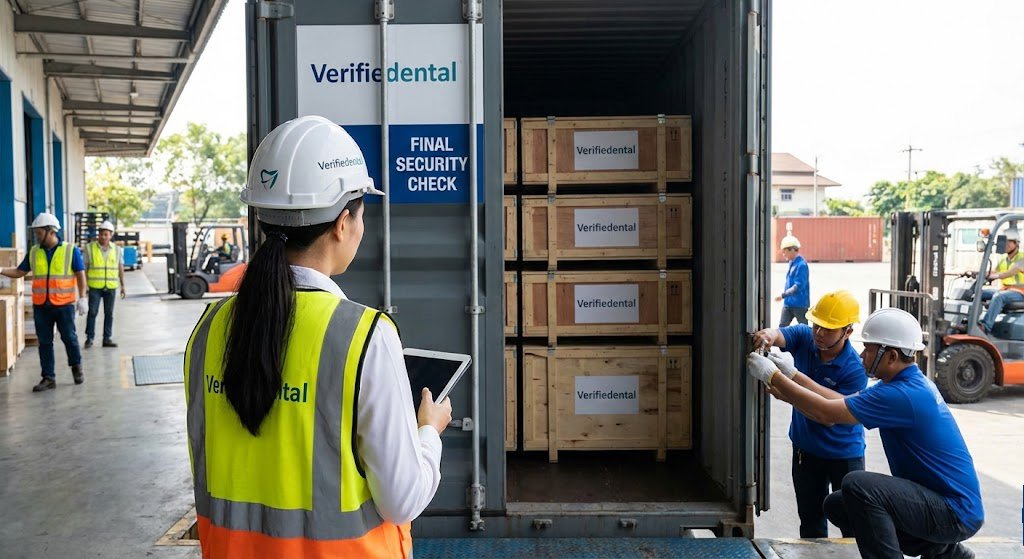
The Fix: Loading Check. Supervise the loading process. Ensure “Heavy on Bottom, Light on Top,” and verify ISPM 15 stamps on all wood materials.
Hurdle 6: The After-Sales Gap
The Risk: The “Ghosting” Supplier.
The sale doesn’t end when the goods leave the port. In fact, that’s when the real test begins. Dental equipment wears out. Solenoid valves clog, O-rings dry out, and bulbs blow.
The “Ghosting” Phenomenon: Many Chinese factories are excellent at sales but terrible at service. Once they have your money, their response time drops. If a unit breaks down in 6 months, shipping it back to China is financially impossible. If the factory ignores your emails for spare parts, your reputation with the local dentist is ruined.
The “Spare Parts Strategy”: Never import “naked” machines.
The 10% Rule: Always negotiate a spare parts package worth 5-10% of the order value. Include high-failure items: Solenoid valves, PCBs, fuses, and O-ring kits.
Documentation: Demand English service manuals and circuit diagrams. Most factory manuals are in “Chinglish” and useless for repair. Ensure you have readable technical docs.
The Fix: Warranty Enforcement. Having a local partner like Verifiedental allows you to pressure the factory for support and manage a steady stream of spare parts.
What Verifiedental Can Do For You
Feeling overwhelmed? You should be. Sourcing medical equipment is complex. But you don’t have to navigate it alone.
Verifiedental is your boots-on-the-ground partner in China. We exist to eliminate the uncertainty between your order and your delivery. Here is how we clear the hurdles for you:
Supplier Verification: We audit the factory legally and physically. No more middlemen masquerading as manufacturers.
Compliance Check: We validate every CE, FDA, and ISO document against official databases to ensure you are legally safe.
Production Monitoring (DPI): We inspect the “guts” of your equipment during assembly to prevent the “Golden Sample” bait-and-switch.
Order Follow-up: We translate your technical requirements (Voltage, Plugs, Specs) into language the factory engineers understand, ensuring no technical mismatches.
Loading Check: We stand by the container door to ensure safe stacking and compliant packaging (ISPM 15).
After-Sales Support: We act as your local office to handle warranty claims and spare parts procurement.
We are not just inspectors; we are your remote supply chain management team
Conclusion & Call to Action
Sourcing dental equipment from China offers a massive opportunity to improve your margins and grow your market share. But the gap between a “Great Deal” and a “Total Loss” lies in the details—the certificate validity, the motor frequency, the packaging wood, and the internal components.
Don’t let these 6 hurdles trip you up. Professional verification is not an expense; it is an insurance policy for your business continuity.
Ready to secure your next shipment?
Download Our Checklist: Get the full Verifiedental Import Technical Checklist to attach to your next Purchase Order.
Get a Free Consultation: Have a supplier in mind but feeling unsure? Let us do a preliminary background check for you.
[Contact Verifiedental Today – Secure Your Supply Chain]
Frequently Asked Questions (FAQ)
Q: Can I trust the CE certificate the factory sent me via email?
A: Not always. It is common for factories to send expired or forged certificates. You must verify the certificate number on the Notified Body’s official website (e.g., TUV Sud, SGS) or use Verifiedental’s Compliance Check service to do it for you.
Q: My country uses 220V, and China uses 220V. Do I still need to worry about the motor?
A: Yes, if your frequency is 60Hz (e.g., Saudi Arabia, Brazil, Philippines). China uses 50Hz. Running a 50Hz AC motor on a 60Hz power supply will cause it to run 20% faster, overheat, and likely fail prematurely. You must specify “60Hz Compatible Motors” in your contract.
Q: How do I distinguish a Trading Company from a Factory?
A: Check their Business License. The “Business Scope” must include “Production”or “Manufacturing” . If it only says “Sales”, they are a trader. A physical factory audit is the most reliable way to confirm this.
Q: What is the best way to pay a Chinese supplier to minimize risk?
A: Never pay 100% upfront. The standard is 30% Deposit / 70% Balance. Crucially, make the 70% balance payment conditional on a successful Pre-Shipment Inspection (PSI) report. If the goods fail inspection, you still hold the leverage of the remaining funds.